
Uncategorized
How to Substitute Honey for Sugar in Baking (Easy Guide)
Nov
Want to bake with something more natural than white sugar? You can substitute honey for sugar in most cakes, muffins, breads and cookies — you just need a few small adjustments. Honey is sweeter than sugar, it is a liquid, and it browns faster, so the recipe needs a little balancing. Here is the simple method that works.
The 4 golden rules
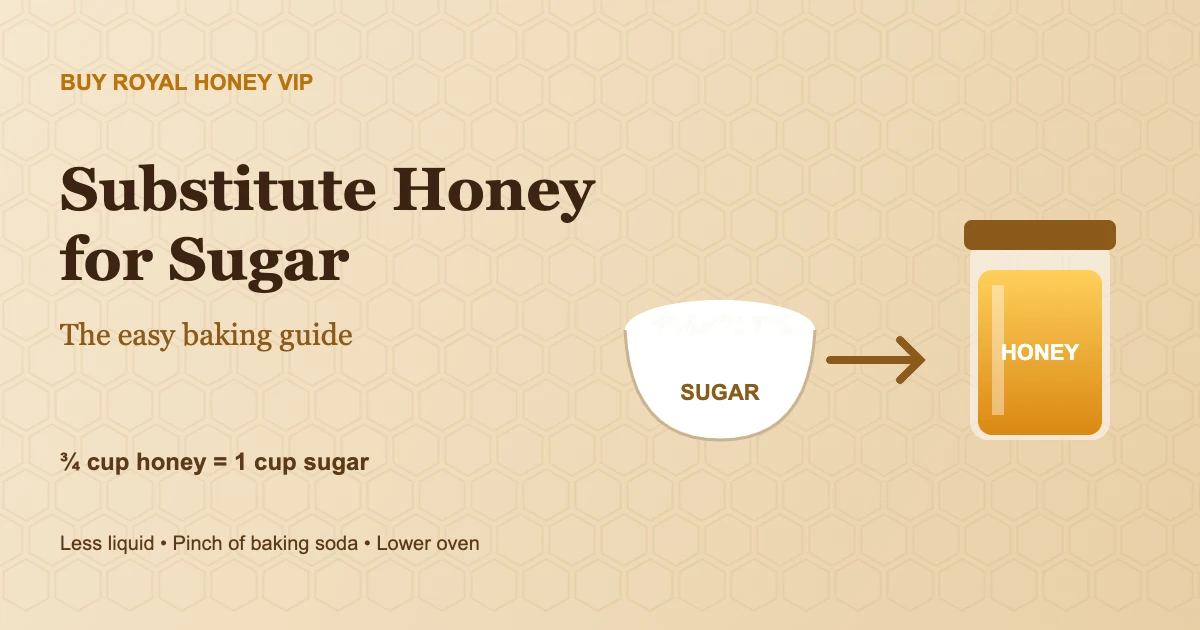
- Use less honey. Use about ¾ cup of honey for every 1 cup of sugar. Honey is sweeter, so you need less. If you like things less sweet, go down to ½–⅔ cup.
- Reduce the other liquid. Honey is about 17% water, so cut the milk, water or juice by ¼ cup (60 ml) for every cup of honey you use.
- Add a pinch of baking soda. Honey is slightly acidic. Add about ¼ teaspoon of baking soda per cup of honey to balance it and help the bake rise (skip this if the recipe already has plenty of baking soda).
- Lower the oven. Honey caramelises faster than sugar, so reduce the temperature by about 15 °C (25 °F) and start checking a few minutes early.
Honey for sugar conversion chart
| Sugar in recipe | Honey to use | Reduce liquid by | Baking soda to add |
|---|---|---|---|
| 1 cup (200 g) | ¾ cup (about 255 g) | ¼ cup (60 ml) | ¼ tsp |
| ¾ cup (150 g) | ½ cup + 1 tbsp (about 190 g) | 3 tbsp (45 ml) | a pinch |
| ½ cup (100 g) | 6 tbsp (about 130 g) | 2 tbsp (30 ml) | a pinch |
| ¼ cup (50 g) | 3 tbsp (about 65 g) | 1 tbsp (15 ml) | not needed |
Weights are approximate; a cup of honey weighs roughly 340 g because honey is much denser than sugar.
Which honey is best for baking?
- Mild, light honey such as acacia, clover or wildflower lets the other flavours shine — ideal for vanilla cakes and cookies.
- Darker, stronger honey such as buckwheat or chestnut works in gingerbread, spice cakes, rye bread and barbecue glazes.
- Premium honeys like Sidr or Manuka are best enjoyed raw — drizzled over a finished cake, pancakes or yoghurt — so their special flavour isn’t lost in the oven.
Not sure which flavour you like? Our guide to the types of honey compares 12 popular varieties.
Practical tips
Measuring honey without the mess
Lightly oil your measuring cup or spoon first (or measure the oil in the recipe before the honey). The honey will slide straight out. If your honey has crystallised, warm the jar gently in warm water first — see how to store honey.
Mix it in properly
Beat honey together with the butter, oil or eggs so it spreads evenly, rather than adding it last.
Expect a softer, moister bake
Honey attracts moisture, so cakes and breads stay soft for longer. The flip side is that cookies come out chewier, not crisp.
Watch the colour
Bakes made with honey turn golden-brown sooner. If the top is browning before the middle is cooked, cover it loosely with foil.
When not to swap honey for sugar
- Meringues and macarons need dry, granulated sugar to form a stable structure.
- Very crisp cookies and shortbread will turn soft and chewy.
- Recipes that cream butter and sugar for lightness (like some sponge cakes) may be denser. Try swapping only half the sugar first.
- Candy and caramel follow precise sugar chemistry, so stick with the original recipe.
Is it healthier?
Honey has a little more flavour and small amounts of antioxidants that white sugar lacks, and because it’s sweeter you can use less. But honey is still sugar, so a honey cake is still a treat. Read Is honey good for you? for what the science says. One safety note: do not give honey — including honey-sweetened bakes — to babies under 12 months.
Quick example: honey banana muffins
If a muffin recipe asks for 1 cup sugar and 1 cup milk, use ¾ cup honey and ¾ cup milk, add ¼ tsp extra baking soda, and bake at 175 °C instead of 190 °C, checking from 5 minutes before the stated time.
Find your baking honey
Stock up from our natural honey collection, or treat yourself to Sidr honey or Manuka honey for drizzling. Delivery details are on our shipping & returns page, and the FAQ answers common questions.
Read more: Types of Honey · How to Store Honey · Real or Fake Honey?
